Investment Bank News: BofA Q2 Banking Fees Jump 50% to $2.1B
Bank of America reported Q2 net income of $9.1 billion, with investment banking fees up 50% to $2.1 billion and sales and trading revenue of $7.1 billion.
CHARLOTTE, N.C. — Bank of America said Tuesday that investment banking fees rose 50% from a year earlier to $2.1 billion in the second quarter, the headline figure in an earnings report that put net income at $9.1 billion. The quarter is a useful marker in investment bank news because it shows how much capital markets activity added to a bank better known for its consumer deposits.
The company’s 8-K, filed July 14, attaches the earnings release as Exhibit 99.1. Net income was $9.1 billion, up 27% from $7.2 billion, and diluted earnings per share were $1.21 against $0.90, a 34% increase. Revenue net of interest expense rose 15% to $31.6 billion, and net interest income grew 9% to $16.0 billion.
Investment banking and trading
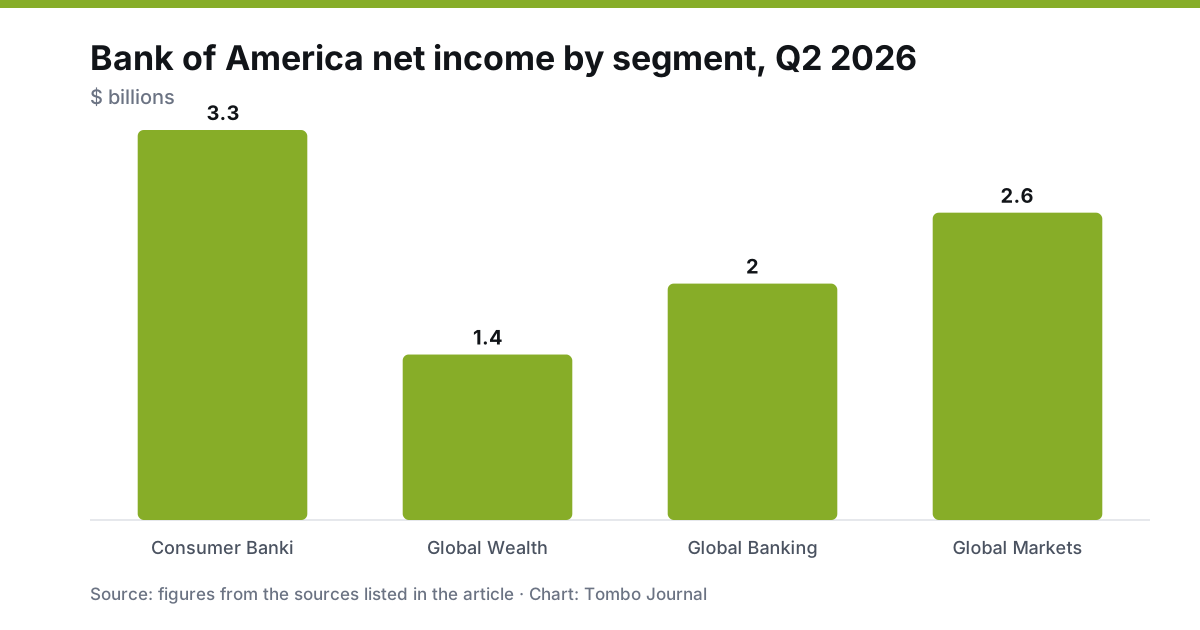
Total corporation investment banking fees, excluding self-led deals, were $2.1 billion. They sit inside the Global Banking segment, which earned $2.0 billion.
Global Markets earned $2.6 billion. Sales and trading revenue was $7.1 billion, including a net debit valuation adjustment loss of $57 million, and rose 33% with or without that adjustment. The bank called it the 17th consecutive quarter of year-over-year growth. Equities revenue increased 70% to $3.6 billion, while fixed income, currencies and commodities revenue gained 9% to $3.5 billion.
Chief executive Brian Moynihan said pipelines remain strong and commercial borrowing has picked up.
Other segments
Consumer Banking earned $3.3 billion on revenue of $11.3 billion, up 5%. Global Wealth and Investment Management earned $1.4 billion on revenue of $6.9 billion, up 16%, with asset management fees up 19% to $4.4 billion. Client balances in that unit reached $4.9 trillion.
Expenses were $18.6 billion, up 8%, which the company said was driven equally by revenue-related costs and investments in people, brand and technology. Operating leverage was 6.6%, and the efficiency ratio improved by roughly 360 basis points from a year ago.
Provision for credit losses was $1.4 billion, down from $1.6 billion in the second quarter of 2025 and roughly flat with the first quarter. Net charge-offs were $1.4 billion, compared with $1.5 billion a year earlier.
Beyond the trading floor
The bank added more than 160,000 net new consumer checking accounts, its 30th consecutive quarter of net growth, bringing the total to 38.7 million, of which 92% are primary accounts. Average consumer deposits were $957 billion. In Global Banking, average deposits rose 8% to $652 billion, average loans and leases rose 7%, and treasury service charges improved 10%.
In wealth management, assets under management reached $2.3 trillion, up 17%, and the unit added about 6,000 net new relationships with $500,000 or more across Merrill and the Private Bank. Average loans there grew 14% to $270 billion.
Reading the numbers
Moynihan said every business segment reported double-digit net income growth. The fee increase is large relative to the 15% rise in total revenue, which means capital markets work contributed more to growth than its share of the revenue base. Equities trading, up 70%, did the same on the markets side.
The release does not break out which products drove the fee increase, so the mix between equity underwriting, debt underwriting and advisory is a question for the 10-Q and for industry data.
What to watch
Third-quarter fee trends and whether commercial loan growth continues are the next tests. League table data for the quarter will show how the bank ranked against rivals reporting the same week.
Prepared with AI assistance from public sources and reviewed under our editorial policy. Not investment advice.