Investment Bank News: Citi Banking ECM Revenue Surges 77%
Citigroup's 10-Q shows Banking unit equity underwriting revenue up 77% while advisory and debt fell, and Citi registers floating-rate notes on the NYSE.
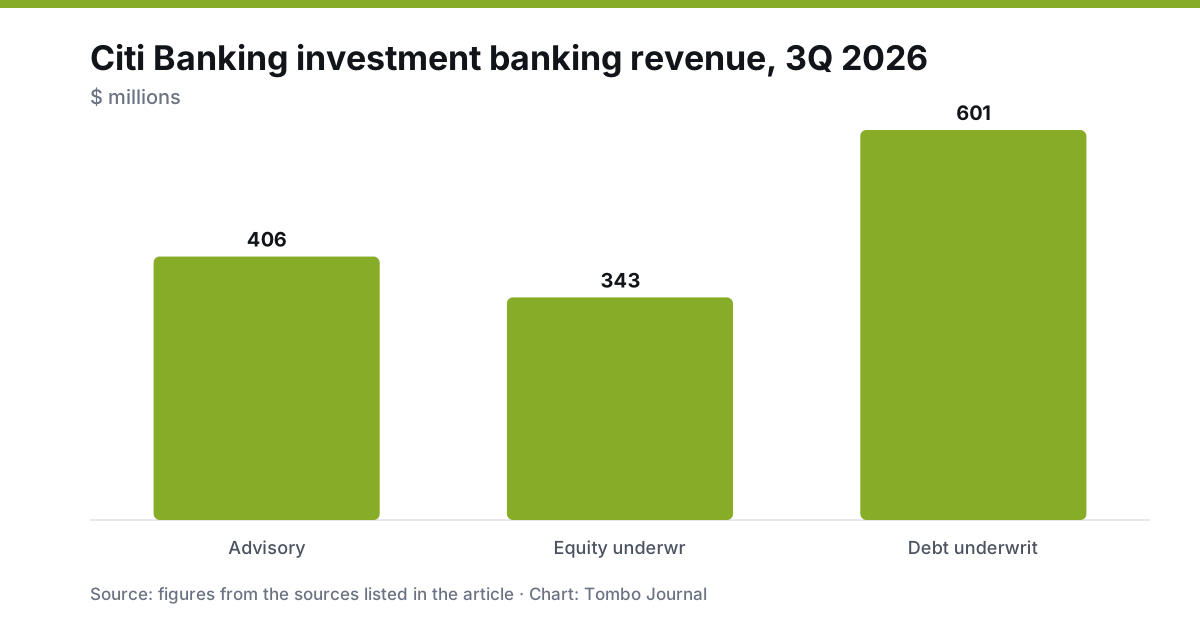
NEW YORK — Citigroup’s third-quarter report shows its investment bank leaning on equity capital markets rather than merger advice. In the Banking segment, equity underwriting revenue rose 77% from a year earlier, while advisory revenue fell 4% and debt underwriting slipped 3%, according to the firm’s Form 10-Q filed with the SEC on Nov. 5.
Banking segment breakdown
Banking revenue was $1.74 billion, up 6%, and net income was $378 million, up 40%. Investment banking revenue was $1.35 billion, up 9%, split as follows.
| Investment banking revenue | 3Q 2026 | 3Q 2025 | Change |
|---|---|---|---|
| Advisory | $406 million | $425 million | down 4% |
| Equity underwriting | $343 million | $194 million | up 77% |
| Debt underwriting | $601 million | $619 million | down 3% |
The 10-Q attributes the equity increase to fee growth across products. It describes advisory as a decline against a strong prior-year quarter, and the debt underwriting decrease as lower investment-grade activity partly offset by growth in leveraged finance. Corporate lending revenue was $382 million excluding the effect of loan hedges, down 16% on lower loan spreads, though average loan balances and commitments were higher. Including a $9 million gain on loan hedges, against a $44 million loss a year earlier, total Banking revenue rose 6%.
The nine-month figures are stronger across the board. Investment banking revenue was $4.22 billion, up 23%, with equity underwriting at $1.03 billion, up 86%, debt underwriting at $1.90 billion, up 17%, and advisory at $1.30 billion, up 3%. Banking net income for the nine months was $1.03 billion, against $586 million a year earlier.
What the mix says about the quarter
Fee data from different banks are not directly comparable, since each defines segments and credit differently, but the direction at Citi is clear: the quarter’s growth came from share sales and not from merger advice. The pattern is useful when reading league tables, where rankings by announced M&A can diverge from rankings by revenue earned on equity offerings.
Citi’s quarter is a reminder that a bank can climb in underwriting while slipping in advisory, and that the two lines move on different calendars.
Firmwide results and capital
Citigroup reported net income of $5.2 billion, or $2.85 per share, up 40% from $3.8 billion a year earlier, a period that included a $726 million goodwill impairment charge tied to the Banamex equity stake sale. Revenue was $23.8 billion, up 8%, helped by Services, Wealth, Markets and Banking. Citi repurchased $3.0 billion of common stock in the quarter and $13.3 billion over nine months.
The Common Equity Tier 1 ratio under the Standardized approach was 12.8% at Sept. 30, down from 13.3% a year earlier, as buybacks, dividends and higher risk-weighted assets outweighed earnings. The firm’s stress capital buffer remains 3.6% through Dec. 31, 2027, and its regulatory CET1 requirement is 11.6%.
A new note listing
Separately, Citigroup and Citigroup Global Markets Holdings filed a Form 8-A on Nov. 9 to register Medium-Term Senior Notes, Series N, Floating Rate Notes due Nov. 7, 2031, on the New York Stock Exchange. The pricing supplement is dated Nov. 2. The notes are unsecured, issued by Citigroup Global Markets Holdings and guaranteed by Citigroup Inc., with a stated principal amount of $1,000 per note. They pay interest at compounded SOFR plus 1.00%, with a floor of 0.00%, and the original issue date is Nov. 9.
What to watch
The next quarter will show whether equity capital markets revenue stays elevated at Citi and whether advisory recovers from the 4% decline. For the notes, investors should watch the NYSE listing date and how the floating-rate coupon resets against SOFR.
Prepared with AI assistance from public sources and reviewed under our editorial policy. Not investment advice.