JPMorgan News: 10-Q Shows Advisory Fees Up 32%, No. 1 Rank
JPMorgan's third-quarter 10-Q shows firmwide investment banking fees of $2.96 billion, advisory revenue up 32%, a No. 1 global ranking and a 14.0% CET1 ratio.
NEW YORK — JPMorgan Chase’s quarterly report, filed with the SEC on Nov. 3, supplies the fine print behind a third quarter in which advisory work did most of the lifting in its investment bank. The Form 10-Q for the period ended Sept. 30 puts firmwide investment banking fees at $2.96 billion, up 13% from a year earlier, and says the firm ranked first for global investment banking fees in the quarter, according to Dealogic.
The fee lines inside the investment bank
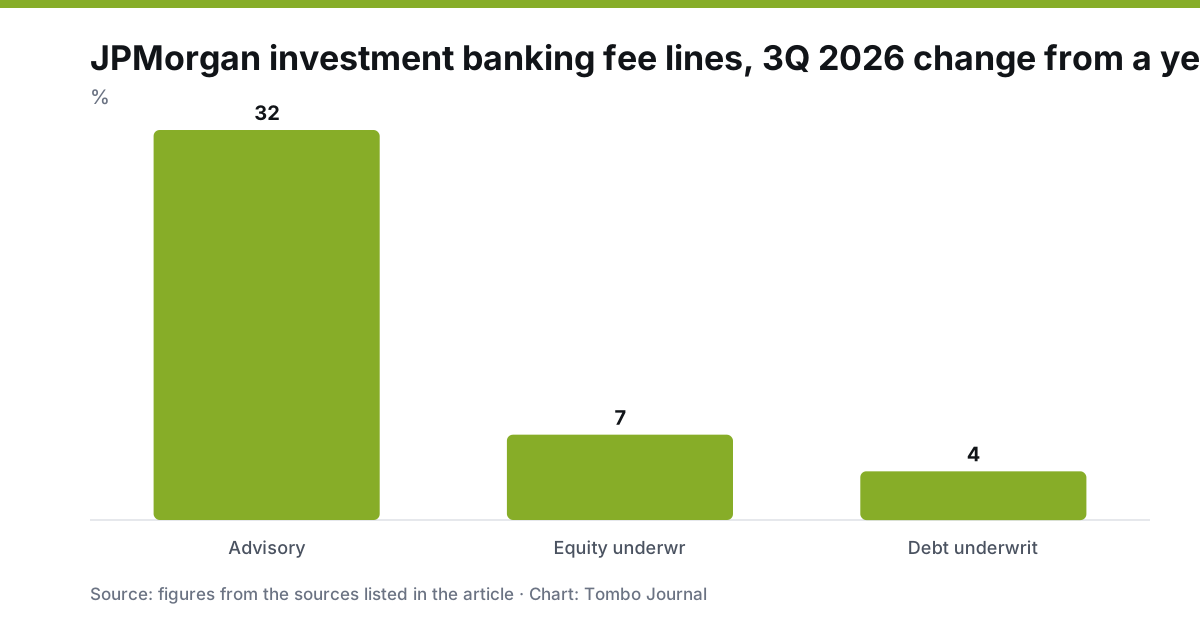
The corporate and investment bank’s own measure of fees rose 14% from the third quarter of 2025, though they were down 8% from the second quarter. The filing breaks the quarter into three parts.
- Advisory fees were $1.2 billion, up 32%, on higher fees from deals in healthcare, diversified industries and technology, partly offset by weaker fees in the financial institutions sector.
- Equity underwriting fees were $564 million, up 7%, helped by follow-on offerings but held back by lower revenue from private placements.
- Debt underwriting fees were $1.2 billion, up 4%, with higher non-investment grade loan fees largely offset by lower non-investment grade bond fees.
Investment banking revenue in the segment was $3.1 billion, up 15%. For the nine months, firmwide investment banking fees reached $9.03 billion against $7.29 billion a year earlier, a 24% increase. Within the corporate and investment bank, advisory fees for the nine months were $3.5 billion, up 42%, and equity underwriting fees were $1.9 billion, up 42%. Debt underwriting fees for the period were $3.8 billion, up 5%.
Rankings and the league-table lens
The 10-Q cites Dealogic data as of Oct. 1 for the firm’s standing: first for global investment banking fees, with 9.2% wallet share year to date. League-table rankings measure share of fees or deal volume at a point in time, so they can move as deals complete or are credited. They also do not translate one for one into revenue, which is why the filing reports the fee lines alongside the ranking.
A first-place ranking and a 32% advisory gain describe the same quarter from two angles, one relative to rivals and one relative to the bank’s own history.
Markets and the rest of the firm
The wider results show how much the investment bank sits beside trading. Firmwide net income was $15.3 billion, up 6%, with earnings per share of $5.57 and a return on tangible common equity of 20%. Those figures include $658 million of net investment securities losses in Treasury and the chief investment office. Net revenue was $50.2 billion, up 8%, and noninterest expense was $27.3 billion, up 12%, driven largely by higher revenue-related compensation.
In the corporate and investment bank, markets revenue was $10.3 billion, up 15%. Equity markets revenue rose 49% to $5.0 billion, led by prime brokerage and derivatives, while fixed income markets revenue fell 4% to $5.4 billion. Net income for the segment was $8.2 billion, up 20%.
Capital position
The firm’s Standardized common equity Tier 1 capital ratio was 14.0% at Sept. 30, compared with 14.6% at the end of 2025 and a requirement of 11.5%, including regulatory buffers. CET1 capital rose to $304.1 billion from $288.5 billion over the nine months, while risk-weighted assets grew to $2.18 trillion from $1.98 trillion. The stress capital buffer requirement is 2.5% and the filing says it stays in effect through Dec. 31, 2027.
What to watch
The fourth-quarter fee mix is the next test of whether advisory strength continues once the sectors cited in the filing, healthcare, diversified industries and technology, finish their current deal cycles. Readers should also watch whether financial institutions advisory, the one area the 10-Q describes as lower, recovers, and how year-end league-table data from Dealogic compare with the 9.2% year-to-date share.
Prepared with AI assistance from public sources and reviewed under our editorial policy. Not investment advice.